4. Translucency, Signature Subsumption, and Sharing Constraints
Translucency
Previously, I defined signatures as a declarations of three types of components:
- Data types defining the sorts of entities that can be manipulated
- Operations to be performed on the entities
- Laws constraining what behaviors the signature’s clients may observe when invoking a sequence of its operations
But I presented a limited view of the first type of component: datatypes. They were all opaque names, signifying the existence of some datatype without defining its representation. In other words, they were abstract types, such as t in the leading AgeMap example:
module type AgeMap = sig
  type t
  val insert : t -> string -> int -> unit
  val get : t -> string -> int
  ...
end
However, in addition to these opaque type declarations, OCaml signatures may also contain transparent type declarations:
module type AgeMap = sig
  type t
  (** A map from names to ages *)

  type name = string
  (** The type of names used by the age map *)

  val insert : t -> name -> int -> unit
  val get : t -> name -> int

  ...
end
A transparent type declaration like name above defines exactly how the datatype is represented. In this case, the transparent declaration indicates to clients of the AgeMap signature that any struct implementing AgeMap implements name using string. Clients can therefore use values of type string where values of type AgeMap.name are expected, e.g. given a value v of type AgeMap.t a client of the AgeMap signature can perform the function application AgeMap.insert v "Ralph" 31.
The combination of opaque and transparent type declarations is often called translucency. At first, it may seem superficial; above, name simply serves as an alias for the type string. But at a practical level, the aliases may name complex datatypes that become unwieldy to type out multiple times across a signature. Furthermore, the right-hand side of a transparent type may be a complex type expression whose component types include both abstract types declared within the same signature, and concrete types visible from outside the signature, for example:
module type KVMap = sig
  type key
  type value
  type entry = key * value
  ...
end
There are yet more fundamental reasons to include transparent type declarations, which I will proceed to discuss.
Signature Subsumption
Suppose we have a module M sealed with signature S. If T is a signature with “fewer requirements” than S, we should be able to pass M into contexts where modules of signature T are expected. When this is the case, we say that S is subsumed by T and write S <: T.
A signature includes various types of requirements any structs considered to implement it:
- For an opaque or transparent declaration of a type named t, the struct is required to have a type component named t.
- For a transparent type declaration of a type named t as the type \(\tau\), the struct must have a type component named t defined as \(\tau\).
- For a value declaration “val x : \(\tau\)”, the struct must have a value binding named x whose type is inferred or ascribed as \(\tau\).
- And informally, the value declarations are required to satisfy all laws included in the signature.
This suggests an algorithm for checking that S <: T is true.
- For each opaque declaration “type t” in T, check that S declares a type named t which is either opaque (“type t”) or transparently defined as any type \(\tau\) (“type t = \(\tau\)”).
- For each transparent declaration “type t = \(\tau\)” in T, check that S declares “type t = \(\tau\)”.
- For each declaration “val x : \(\tau\)” in T, check that S has a declaration “val x : \(\tau\)”.
- Check that the conjunction of the laws of S imply the conjunction of the laws of T.
Points (1)-(3) are handled by the OCaml type checker, but point (4) is beyond its scope. Also note that when S <: T, S may contain type and value components whose names do not match the names of any type and value components of T.
Sharing Constraints
So far, we’ve seen one signature constructor form:
\[\mathsf{sig~...~end}\]Above, \(\mathsf{...}\) is a placeholder for a list of the signature’s components.
The sharing constraint is another useful signature constructor. It has the following form:
\[\mathsf{S~with~type~t} = \tau\]Above, \(\mathsf S\) must be a signature that has an opaque type component named t and \(\tau\) may be an arbitrary type expression. This constructor is considered ill formed whenever either \(\mathsf S\) has no type component t or S has a transparent type component t. Thus, whenever the signature \(\mathsf{S~with~type~t} = \tau\) is well formed, we know that \((\mathsf{S~with~type~t} = \tau) <: \mathsf S\).
Here is an example usage of sharing constraints. Recall the TraverseGraph signature from my first post:
module type TraverseGraph = sig
  (** An undirected graph of location nodes, only some of which are traversable.
      This graph is static, in that traversability and adjacency do not change over time.
  *)

  type node
  (** A node in a graph *)

  val compare_node : node -> node -> int
  (** [compare_node n m] Returns 0 iff node [n] equals node [m] *)

  val adjacent_nodes : node -> node list
  (** [adjacent_nodes n] All traversable nodes adjacent to node [n] *)

  (* LAW:
     The relation Eq defined such that

     n Eq m <=> (compare_node n m = 0)

     is an equivalence relation (reflexive, symmetric, and transitive)
  *)

  (* LAW:
     The relation Lt defined such that

     n Lt m <=> (compare_node n m < 0)

     is a strict total order (transitive, irreflexive, and trichotomy w.r.t. Eq)
  *)

  (* LAW:
    n Eq m => (adjacent_nodes n = adjacent_nodes m)
  *)
end
Consider the following graph:
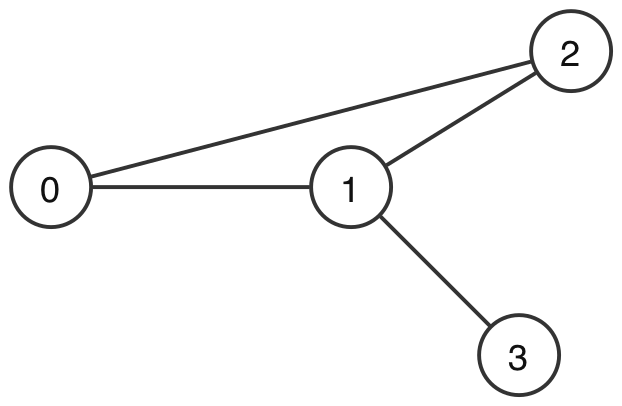
A struct implementing TraverseGraph, using int as the node type and providing the above graph follows:
module MyGraph : (TraverseGraph with type node = int) = struct
  type node = int
  let compare_node (a : int) (b : int) = a - b
  let adjacent_nodes (n : int) =
    match n with
    | 0 -> [1 ; 2]
    | 1 -> [0 ; 2 ; 3]
    | 2 -> [0 ; 1]
    | 3 -> [1]
    | _ ->
      failwith "invalid node"
end
Then we can pass the struct into our BFS function and print its result:
let () =
  let opt_path = shortest_path (module MyGraph) 0 2 in
  match opt_path with
  | Some(path) ->
    List.iter (fun n -> Printf.printf "%d\n" n) path
  | None ->
    Printf.printf "no path\n"
which prints the following output:
0
2
Sealing MyGraph with \(\mathsf{TraverseGraph}~\mathsf{with}~\mathsf{type}~\mathsf{node} = \mathsf{int}\) ensures that if they type checker succeeds then MyGraph can be sealed with \(\mathsf{TraverseGraph}\) in the future without initially sealing off node with an abstract type.
If we had sealed MyGraph using TraverseGraph instead of the sharing constrained version, we would not have been able to call shortest_path, because there would have been no way to obtain any elements of type MyGraph.node. In fact, sealing directly with TraverseGraph would leave us with a totally useless module: with no way to obtain an element of type MyGraph.node, neither of the operations adjacenct_nodes nor compare_node can be called.
This example has demonstrated just one way to use a type sharing constraint. There are multiple others that we will see shortly in the following posts.
Different Kinds of Opaque Declarations
Recall the Queue signature from the first post, which I’ll reproduce below:
module type Queue = sig
  (** The standard functional queue ADT *)

  type 'a t
  (** A functional queue whose elements have type ['a] *)

  val empty : 'a t
  (** An empty queue *)

  val push : 'a t -> 'a -> 'a t
  (**
    [q' = push q v] pushes element [v] onto the back of queue [q] to
    obtain [q']
  *)

  val pop : 'a t -> 'a * 'a t
  (** [(a, q') = pop q] Pops front [a] of the queue [q], yielding [q']

      ## Requires

      * [not (is_empty q)]

      ## Returns

      * a:'a - The element popped from the front of [q]

      * q':'a t - The queue resulting from popping the front off [q]
  *)

  val is_empty : 'a t -> bool
  (** [is_empty q] Is queue [q] empty? *)

  (* LAW:
    The sequence underlying the queue named "empty" (defined above) is the empty sequence
  *)

  (* LAW:

    If s is the sequence of elements of type 'a underlying a queue q then
    [is_empty q] is true iff s is the empty sequence

  *)

  (* LAW:

     If s is the sequence of elements underlying a queue q,
     then the sequence underlying [push q a] is s ++ [a] (a appended to the end of s)

  *)

  (* LAW:

     If [a] ++ s (element a prepended to the sequence s) is the sequence of elements underlying
     a queue q, then [pop q] = (a, q'), where the sequence underlying queue q' is s
  *)
end
It declares an opaque family of types 'a t. These opaque types are fundamentally different than the the opaque type TraverseGraph.node, in the sense that they are intended to hide their concrete representations. These type declarations occur in signatures that seal structs immediately once they’ve been created. On the other hand, the TraverseGraph.node declares a placeholder for a type drawn from some outside context; its intended use involves submsumption and/or sharing constraints.
Earlier, I claimed “modules are like vending machines”, in the sense that they provide laws governing their interactions, isolating us from complex internal representations. The signature \(\mathsf{TraverseGraph}~\mathsf{with}~\mathsf{type}~\mathsf{node}=\mathsf{int}\), on the other hand, doesn’t isolate us from anything. Yet it still has laws that govern our interaction with it. So in this sense, it may be viewed as a degenerate vending machine that provides operations on existing datatypes without encapsulating any new datatypes of its own. Then, subsuming into TraverseGraph (as when we apply the shortest_path function) allows us to temporarily view TraverseGraph.node type as abstract in a local context.
Conclusion
OCaml signatures may contain both opaque type declarations, which hide a structs’ type components behind abstractions, and transparent type declarations, which expose structs’ type components in full to their clients. Transparent type declarations can be subsumed into opaque type declarations local contexts via signature subsumption. Sharing constraints allow us to strengthen a signature by replacing an opaque type component with a transparent one.
I will demonstrate all these concepts in the next post, which introduces functors, which are essentially functions from modules to modules, implementing vending machines in terms of vending machines.